



Basement Wall Sealing in Bridgeport
Bridgeport sits where the Pequonnock River meets Long Island Sound, and that geography writes the story of every wet basement in the city. On the low coastal ground near the harbor, the water table stays high and pushes against foundation walls all year. Inland, up the hills toward the North End and around Trumbull, glacial till and granite ledge trap water against the foundation after every heavy rain. The housing stock makes it worse: 1870s to 1910s Victorian and Italianate homes in Black Rock and Stratfield sit on old brick and fieldstone foundations, and the 1900s to 1940s two- and three-family homes across the East Side have full basements that have been taking water for a century. Basement Wall Sealing in Bridgeport starts with one honest question: is the wall just damp, or is hydrostatic pressure driving water through it? Sealant fixes the first problem and fails at the second, and we tell you which one you actually have before we quote anything. If you want the full diagnostic picture, start with a free basement inspection.
Why Bridgeport Basements Take Water: Old Brick, High Water Table, and Nor'easters
Three local conditions drive almost every sealing call we get. First, the foundation material. Old brick and fieldstone in Black Rock, Stratfield, and around Washington Park were laid with lime mortar that softens and erodes over decades of wet-dry cycling. Second, the ground. Shoreline blocks near the harbor sit on a high water table, and hillside lots in the North End sit on glacial clay soil that holds water like a bathtub. Third, the weather. Nor'easters and coastal storm surge (Sandy in 2012 being the benchmark) drive water against walls, and hard freeze-thaw cycles open hairline cracks every winter. The failure mode that dominates here is wall seepage after heavy rain, often showing up as efflorescence, a white chalky bloom on the block or brick.
- Brick and fieldstone foundations in Black Rock and Stratfield wick water through mortar joints and need parging before any sealer goes on.
- Poured-concrete basements in Fairfield, Trumbull, Shelton, and Monroe crack at cold joints and form tie holes, which seep under hydrostatic pressure.
- Two- and three-family homes on the East Side often have multiple damp walls, and sealing one wall without addressing the drain tile means the water finds the next seam.
- Homes near the shore deal with a water table that rises with the tide and storm surge, so a surface sealer alone will not hold it back.
- Freeze-thaw cycles open new cracks each winter, so sealing work done in fall lasts longer than work done in the middle of a January thaw.
If any of this sounds familiar, the wall is telling you something. The question is whether it needs a sealer or a drainage fix.
Key info: A homeowner on Grovers Avenue in the East Side had efflorescence on three block walls and assumed a sealer would fix it. The real problem was a failed footing drain and a sump basin that filled within an hour of rain. Sealing the walls would have trapped moisture inside the block. We recommended an interior perimeter drain first, then sealing.
Permits and code questions for structural foundation work in Bridgeport run through the city's building department, and the rules are worth verifying before any structural repair: City of Bridgeport official site.
How We Seal Basement Walls in Bridgeport: Prep, Diagnose, Then Seal
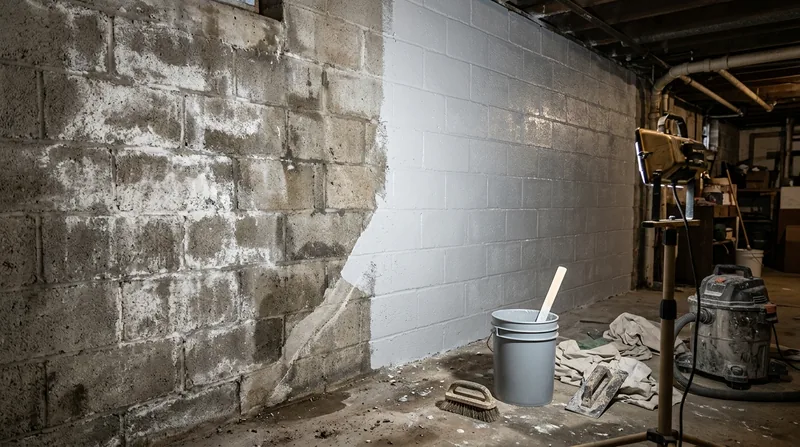
Sealing a damp basement wall is not a matter of rolling on a bucket of sealer. Most of the work happens before the product goes on. We clean the wall, remove efflorescence, repair mortar joints and parge where the brick or block is eroded, and confirm the wall is not actively holding back hydrostatic pressure. If it is, we say so and point you to the right fix instead of selling you a coating that will blister off within a season. The steps below are what a typical job looks like in Bridgeport.
- We inspect the wall from the inside, check for efflorescence, crack patterns, and moisture readings, and look at the drain tile and sump setup to see where water is coming from.
- We wire-brush and wash the wall, then remove efflorescence with a masonry cleaner so the sealer can bond to sound material.
- We repair mortar joints, parge eroded brick and fieldstone, and fill tie holes and cold joints in poured concrete before sealing.
- We apply the sealer, either a penetrating silicate product for damp masonry or a flexible membrane for walls that see minor seepage, depending on what the wall needs.
- We check the exterior grading and downspout extensions, because a sealer cannot outrun a downspout dumping water at the foundation.
- We leave you with a written note on what was sealed and what to watch, plus a transferable warranty on the work.
When the diagnosis points to pressure rather than dampness, the honest answer is usually an interior drain tile system that relieves the water before it reaches the wall.
Key info: A 1920s two-family on Stratford Avenue had a damp fieldstone wall with no active seepage. We parged the eroded mortar, applied a penetrating sealer, and extended two downspouts six feet out. Total job ran two days, and the wall stayed dry through the next spring melt. No drain tile was needed, and we told the owner so.
Sealing Methods We Use on Bridgeport Foundations
Not every wall gets the same treatment. The table below shows the approaches we use and when each one makes sense on Bridgeport housing stock, from Black Rock brick to Fairfield poured concrete.
| Approach | Description | Best for |
|---|---|---|
| Penetrating silicate sealer | Soaks into masonry and reacts with free lime to block capillary moisture without trapping vapor. | Damp brick and block walls with efflorescence and no active seepage. |
| Flexible membrane sealer | Rolls on as a rubberized coating that bridges hairline cracks and resists minor movement. | Poured-concrete walls in Fairfield and Trumbull with minor seepage at cold joints. |
| Parging and mortar repair | Rebuilds eroded mortar joints and fieldstone faces before any sealer is applied. | 1870s to 1910s brick and fieldstone foundations in Black Rock and Stratfield. |
| Crack injection with epoxy or polyurethane | Ports are set along the crack and resin is injected to fill it from the inside out. | Active cracks in poured concrete that seep after rain, where sealing alone will not hold. |
We pick the method after we look at the wall, not before. If a crack is structural or the wall is bowing, sealing is not the answer, and we will say so.
Basement Wall Sealing Cost in Bridgeport: What to Expect
Most basement wall sealing jobs in Bridgeport start around From $1,500, and that figure covers a typical single-wall or small basement job with surface prep, efflorescence removal, parging of minor defects, and the sealer itself. What moves the number up is rarely the sealer. It is the condition of the wall and how much prep it needs. A 1920s fieldstone wall in Black Rock with eroded mortar takes more labor than a 1990s poured wall in Shelton. Access matters too: a finished basement means moving stored items and protecting the floor, and a low-ceiling cellar slows the crew down. If the diagnosis turns up active hydrostatic pressure, the real cost is the drainage fix, and we will tell you that before you spend money on a sealer that cannot hold. Get two or three estimates and compare scope, not just the number. Our full pricing overview breaks down the ranges by job type.
Hiring a Basement Wall Sealing Contractor Near Me in Bridgeport
Bridgeport has plenty of contractors who will sell you a sealer and disappear. A few simple checks separate the specialists from the rest. Ask for proof of licensing and insurance before work starts, and ask whether they carry general liability and workers' compensation. Get at least two or three written estimates and compare what is included, not just the bottom line. Ask for local references, ideally on the same foundation type as yours, because brick and fieldstone work is different from poured concrete. Confirm who pulls any permit if the job touches structural repair or drainage connections, and verify the rules with the Bridgeport building department. If your home is in a historic district, check whether exterior work needs approval before anyone starts. We are a BHA member and carry a transferable warranty on our work. Reach out through our contact page for a free estimate.
Basement Wall Sealing Near Me: What Bridgeport Homeowners Should Know
When you search for basement wall sealing near me in Bridgeport, you will find everything from general handymen to dedicated waterproofing firms. The difference shows up in the diagnosis. A sealer applied over an active leak traps moisture in the wall and makes the problem worse. We look at the wall, the drain tile, the sump, and the grading before we recommend anything, and we will tell you when a simple crack seal is enough and when the real fix is drainage. That is the whole job: an honest read on the wall, then the right fix.
Basement Wall Sealing in Bridgeport: Pricing Guide
| Service | Price | Details |
|---|---|---|
| Single wall sealing with prep | Starting at $1,500 | Covers one wall, efflorescence removal, minor parging, and penetrating or membrane sealer. |
| Full basement wall sealing | Starting at $2,800 | Multiple walls, full prep, parging of defects, and sealer; price rises with wall condition. |
| Crack injection with epoxy or polyurethane | Starting at $650 | Per active crack, includes port setup and resin injection; structural cracks priced on inspection. |
| Complex or large-scale job | On estimate | Fieldstone repair, multiple wall types, or active hydrostatic pressure needs an on-site look. |
| Travel | Included | In Bridgeport and surrounding areas, no separate call-out or mileage fee. |
| Estimate | Free | Response within 24h at (475) 256-5668, no obligation to book. |
Indicative pricing, the exact cost depends on square footage, finish, and site access. Free personalized estimate within 24h at (475) 256-5668.


