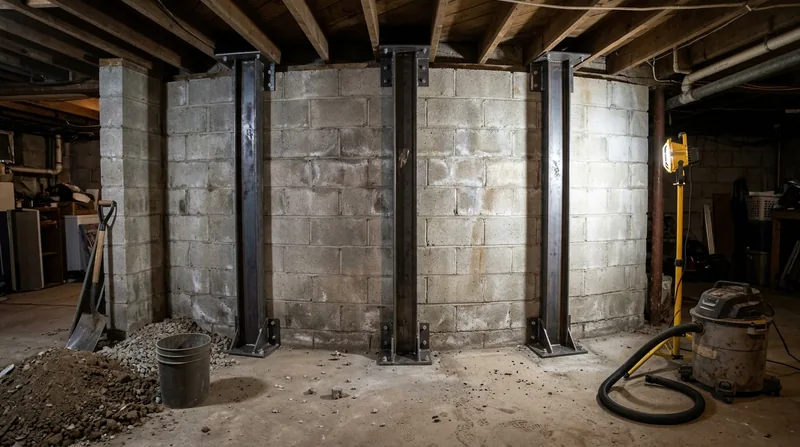




Bowing Wall Repair in Bridgeport: Stabilize the Wall Before It Moves Further
Bridgeport sits where the Pequonnock River meets Long Island Sound, and that geography shows up in the basement walls of every neighborhood from Black Rock to the North End. Victorian and Italianate homes near Washington Park still sit on old brick and fieldstone foundations, while 1900s three-family houses on the East Side and 1940s Capes in the North End rest on block walls that have been absorbing hydrostatic pressure for decades. When saturated glacial till and winter frost push inward, the wall bows, and the horizontal crack at mid-height tells you the movement is active. Bowing Wall Repair in Bridgeport is a structural stabilization job, not a cosmetic patch, and we match the method to the severity of the movement and the soil behind the wall. We are a Basement Health Association member and a dedicated below-grade specialist, not a general foundation firm. If you are seeing a wall lean, call foundation crack repair only after the wall itself is stabilized.
Why Bowing Walls Are Common in Bridgeport's Older Housing Stock
The failure mode that dominates here is saturated glacial till pushing against unreinforced block and brick walls after repeated freeze-thaw cycles. Inland hills in the North End and around Stratfield trap water against the foundation, and the high water table near the shore keeps the soil saturated long after a nor'easter passes. A wall that was plumb in 1950 can be two inches out of line today, and the movement accelerates once the mortar joints open and water reaches the cores.
- Block walls laid without vertical reinforcement bow under lateral soil load.
- Old brick and fieldstone foundations in Black Rock develop bulges where mortar has softened.
- Poor grading and short downspouts concentrate water at the same corner year after year.
- Frost heave in January and February adds pressure that spring snowmelt then finishes.
Any wall showing a horizontal crack, a visible lean, or doors and windows that no longer close squarely needs an inspection before the next winter.
Key info: A two-family home on the East Side with a block wall bowed about one inch at mid-height is a classic Bridgeport case. The cause was a failed footing drain and a downspout that dumped at the same corner for thirty years, not a sudden event.
Structural repair of a foundation wall commonly requires a permit in Connecticut, and thresholds vary by jurisdiction. Verify requirements with the Bridgeport Building Department before work begins: City of Bridgeport.
How We Diagnose and Stabilize a Bowing Wall in Bridgeport
We start by measuring the wall, not guessing at it. A plumb line and a level tell us how far the wall has moved and in which direction, and we check the footing and the soil moisture behind the wall. The repair method follows from that reading: a wall that has moved less than about an inch may only need carbon fiber straps, while a wall two inches out of line needs steel I-beams or wall anchors. We also correct the water source, because stabilizing a wall while the soil stays saturated is a temporary fix.
- We inspect the full wall, the footing, the grading, and the drain tile at the base.
- We measure the deflection and photograph the crack pattern for the record.
- We recommend carbon fiber straps, steel I-beams, or wall anchors based on severity and soil.
- We address the water with an interior drain tile system or exterior drainage correction as needed.
- We verify the repair with a follow-up measurement after installation.
The goal is a wall that stops moving and a basement that stays dry through the next spring melt.
Key info: A 1920s Colonial in Fairfield with a poured-concrete wall bowed about 1.5 inches was stabilized with steel I-beams and an interior perimeter drain. The wall has held its line through three winters since, and the basement is dry after every nor'easter.
Bowing Wall Repair Methods: Matching the Fix to the Movement
Not every bowing wall needs the same repair, and the table below shows how we match the method to the severity of the movement and the soil. A wall that has moved a quarter inch does not need the same treatment as one that has moved two inches, and a brick wall behaves differently from a poured-concrete wall. We choose the lightest method that will actually stop the movement.
| Approach | Description | Best for |
|---|---|---|
| Carbon fiber straps | Straps bonded vertically to the wall and anchored at the floor and ceiling. | Walls bowed less than about one inch with no footing movement. |
| Steel I-beams | Beams set against the wall and tied into the floor and joists. | Walls bowed one to two inches, especially block walls. |
| Wall anchors | Plates on the outside soil side connected to brackets inside. | Walls bowed more than two inches where the soil can be reached. |
| Epoxy or polyurethane injection | Resin injected into cracks to seal them after stabilization. | Cracks that are not the primary structural problem. |
Stabilization comes first, and crack sealing comes after, because sealing a moving wall just hides the problem.
Bowing Wall Repair Cost in Bridgeport: What to Expect
Pricing for bowing wall repair starts at $600 for a limited crack injection and sealing scope, and moves up from there based on the method and the length of wall involved. Carbon fiber straps on a short wall run typically land in the low thousands, steel I-beams cost more because of the steel and the anchoring, and wall anchors cost the most because the excavation on the soil side is part of the job. Access matters: a wall behind a finished basement or under a deck takes longer than a bare wall.
Getting two or three estimates is smart on a structural job, because the diagnosis matters as much as the price. Ask each contractor how they measured the deflection and why they chose the method they proposed. The full pricing overview is on our pricing page, and an on-site inspection is the only way to give you a real number.
Bowing Wall Repair Near Me: What to Check Before You Hire a Contractor Near Bridgeport
Hiring for structural work is different from hiring for a drain cleaning, and a few checks separate a qualified contractor from a sales pitch. Ask for proof of licensing and insurance, and ask for references from jobs similar to yours, not just any job. Confirm who pulls the permit and who is on site doing the work, because the crew matters as much as the company name.
- Verify the contractor carries liability insurance and workers' compensation coverage.
- Get two or three written estimates that describe the method and the measurement.
- Ask for references from bowing wall jobs in Bridgeport or Fairfield County.
- Confirm the permit responsibility in writing before work starts.
- Ask what the follow-up measurement looks like after the repair.
If a contractor cannot explain why they chose a method, keep looking. You can reach us through the contact page to schedule an inspection.
We serve homeowners across Bridgeport and the surrounding towns, including Stratford and Trumbull, where the same saturated till and frost cycles push on older walls.
Bowing Wall Repair in Bridgeport: Pricing Guide
| Service | Price | Details |
|---|---|---|
| Crack injection and sealing | Starting at $600 | Covers a limited crack injection scope after the wall is confirmed stable, with access and crack length moving the price. |
| Carbon fiber strap installation | Starting at $1,800 | Straps bonded and anchored on a short wall run, with wall length and basement finish moving the price. |
| Steel I-beam stabilization | Starting at $3,500 | Includes steel beams tied into floor and joists, with wall length and access behind finishes moving the price. |
| Wall anchor system | On estimate | Requires exterior excavation on the soil side, so the scope needs an on-site look before a number is given. |
| Travel | Included | In Bridgeport and surrounding areas, no separate call-out or mileage fee. |
| Estimate | Free | Response within 24h at (475) 256-5668, no obligation to book. |
Indicative pricing, the exact cost depends on square footage, finish, and site access. Free personalized estimate within 24h at (475) 256-5668.


