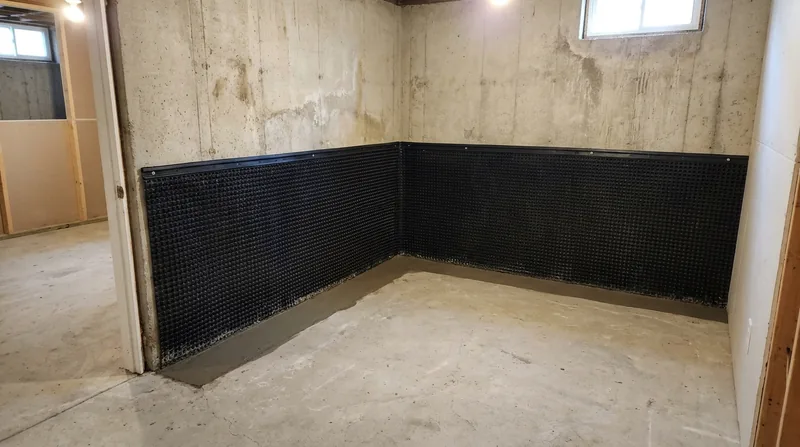




Basement Waterproofing in Bridgeport: Built for Long Island Sound Weather and Old Foundations
Basement Waterproofing in Bridgeport starts with understanding that water here does not follow one path. The city sits where the Pequonnock River meets the harbor, so low coastal ground near the shore carries a high water table that pushes water up through footing drains and slab seams. Inland, glacial till and granite ledge on the hills trap stormwater against foundation walls. Add nor'easters, coastal storm surge like Sandy in 2012, heavy snow and ice dams, and hard freeze-thaw cycles, and you get a wet basement pattern that repeats every spring.
We work on the building stock that actually exists here: 1870s to 1910s Victorian, Queen Anne, and Italianate homes in Black Rock on old brick and fieldstone foundations, 1900s to 1940s two-family and three-family homes on full basements across the East Side, 1940s to 1960s Capes and ranches on block basements in the North End, and 1980s to 2020s Colonials with poured-concrete basements in Fairfield, Trumbull, Shelton, and Monroe. Each foundation type fails differently, and we diagnose before we quote. If you want to see how we handle a specific problem, start with our foundation crack repair page.
We are a dedicated basement waterproofing specialist, not a general foundation-repair firm and not a plumber. That distinction matters when the real problem is hydrostatic pressure rather than a single crack. We tell you plainly when simple crack sealing is enough and when an interior drain tile system is the better answer than exterior excavation.
Why Water Finds Your Basement in Bridgeport
Bridgeport basements fail for reasons you can see above grade and reasons you cannot. The visible ones are grading that slopes back toward the house, downspouts that dump at the foundation, and window wells that fill during a nor'easter. The invisible ones are the water table near the shore and the glacial clay soil inland that holds water like a bathtub until it finds the path of least resistance through mortar joints, fieldstone seams, and cold joints in poured walls.
Freeze-thaw cycles make it worse. Water enters a hairline crack, freezes, expands, and widens the crack through the winter. By spring snowmelt, that crack is a channel. On old brick and fieldstone foundations around Stratfield and Washington Park, the mortar itself is often the weak point, and you will see efflorescence, that white salt bloom, as the first sign that water is moving through the wall.
- Hydrostatic pressure pushes water through the cove joint where the wall meets the footing.
- Failed or clogged footing drains let groundwater sit against the foundation instead of carrying it away.
- Fieldstone and old brick walls wick moisture and lose mortar over decades of freeze-thaw.
- Downspouts and grading route storm rain directly against the wall instead of away from it.
- A high water table near the harbor rises after heavy rain and finds every seam in the slab.
Any one of these can produce a wet basement. Most Bridgeport homes have two or three working at once, which is why a single tube of sealant rarely solves the problem.
Key info: In Black Rock and along the low ground near the Pequonnock, we routinely find water entering at the cove joint during spring high tides combined with rain. In the North End and Stratfield, the same symptom usually traces to glacial till holding water against a block or fieldstone wall. Same wet floor, two different fixes.
For the official word on what work requires a permit and how drainage connections are regulated, check the City of Bridgeport building department before any structural or drainage work begins: City of Bridgeport official site. Rules vary by jurisdiction and must be verified for your address.
How We Waterproof a Bridgeport Basement, Step by Step
We start below grade and work outward from the actual water path. The first visit is a free basement inspection where we trace where water is entering, check the sump basin and discharge line, look for efflorescence and wall seepage, and test whether the drain tile is still moving water or has silted shut. We do not quote a system before we know which failure mode we are dealing with.
- We inspect the interior perimeter, the cove joint, the slab, the walls, and the sump basin, and we note grading and downspout conditions outside.
- We identify whether the driver is hydrostatic pressure, a failed footing drain, wall cracking, or surface water routing.
- We recommend the least invasive system that solves the actual problem, and we explain when crack injection alone is enough.
- We install the system: interior perimeter drain and sump basin, exterior membrane and dimple board, epoxy or polyurethane injection, or a combination.
- We test the sump pump, check valve, and discharge line before we leave, and we walk you through maintenance.
Every recommendation is tied to what we found, not to a package. If your situation calls for interior work, see how our interior drain tile system is built for full basements.
Key info: A 1920s two-family on the East Side had water across the floor after every heavy rain. The footing drain was clay tile, crushed and root-filled. Rather than excavate the whole perimeter, we installed an interior perimeter drain feeding a new sump basin with a check valve and a discharge line routed above grade. The floor stayed dry through the next spring snowmelt.
Waterproofing Methods We Use Below Grade
There is no single method that fits every Bridgeport basement. The table below shows how we match the approach to the foundation type and the water source. We choose based on what the inspection shows, and we tell you when a simpler method will do the job.
| Approach | Description | Best for |
|---|---|---|
| Interior perimeter drain and sump basin | We cut a channel at the perimeter, install drain tile feeding a sump basin, and discharge through a check valve and discharge line. | Hydrostatic pressure and water rising at the cove joint, common on full basements across the East Side. |
| Exterior waterproofing with membrane and dimple board | We excavate to the footing, parge and seal the wall, apply a waterproof membrane and dimple board, and restore drainage. | Poured-concrete walls in Fairfield, Trumbull, and Shelton where exterior access is workable. |
| Epoxy or polyurethane injection | We drill injection ports along the crack and inject epoxy for structural cracks or polyurethane for active leaks. | Isolated wall cracks on poured and block foundations, when the crack is the only water path. |
| Basement wall sealing and vapor barrier | We seal walls and install a vapor barrier to control moisture movement through masonry and concrete. | Damp walls, efflorescence, and musty basement smell without standing water. |
| Sump pump replacement and battery backup | We replace failed pumps and add a battery backup so the system runs through storm-related power outages. | Homes where sump pump failure during a nor'easter is the main risk. |
If a contractor recommends exterior excavation before checking the interior, ask why. In many Bridgeport homes the interior system solves the same problem with less disruption and less cost.
Basement Waterproofing Cost in Bridgeport: What to Expect
Basement waterproofing cost in Bridgeport starts from $2,500 for focused work such as crack injection or wall sealing, and climbs from there based on the system and the access. A full interior perimeter drain with a sump basin typically lands in the middle of the range, and exterior excavation with membrane and dimple board is the highest because it involves digging to the footing and restoring the site.
Several factors move the number. Foundation type matters: fieldstone and old brick in Black Rock and Stratfield take more labor than poured concrete. Access matters: a narrow side yard or a finished basement changes the work. The water source matters: hydrostatic pressure needs a drainage system, while a single active crack may need only injection. Urgency matters too, because emergency calls after a storm surge cost more than planned work.
Get two or three written estimates and compare what is actually included, not just the total. A low number that skips the sump pump, check valve, or discharge line is not the same job. You can see the full range on our pricing page.
Choosing a Basement Waterproofing Contractor Near Me in Bridgeport
Hiring the right contractor near Bridgeport comes down to a few checks that take ten minutes. Ask for proof of licensing and insurance, and ask for the certificate to be sent to you. Get multiple estimates in writing and make sure each one lists the same scope so you can compare. Ask for references from jobs on similar foundations, especially old brick and fieldstone, and ask whether permits are needed for your address.
Permits are commonly required for structural foundation repair, egress window cutting, and work that alters drainage or the sanitary connection of a sump discharge, and thresholds vary by jurisdiction. Always confirm with the local building department. We are a Basement Health Association (BHA) member, and we provide a transferable warranty on our work. Call (475) 256-5668 or use our contact page to schedule a free inspection.
One more check: ask the contractor to explain the water path in plain language. If they cannot tell you where the water is coming from, they are guessing. For a closer look at how we handle the diagnostic step, see our free basement inspection.
Basement Waterproofing in Bridgeport: Pricing Guide
| Service | Price | Details |
|---|---|---|
| Crack injection or wall sealing | Starting at $2,500 | Covers epoxy or polyurethane injection and wall sealing for isolated cracks; price rises with crack length and number of ports. |
| Interior perimeter drain and sump basin | Starting at $4,500 | Includes drain tile, sump basin, check valve, and discharge line; finished basements and narrow access add labor. |
| Exterior waterproofing with membrane and dimple board | Starting at $7,500 | Full excavation to footing with parging, membrane, and drainage; site access and foundation depth drive the number. |
| Sump pump replacement with battery backup | Starting at $1,200 | Includes pump, battery backup, check valve, and discharge test; electrical work or long runs add cost. |
| Complex or large-scale job | On estimate | Fieldstone foundations, multiple water sources, and structural concerns need an on-site inspection before any number is given. |
| Travel and estimate | Included and free | No call-out or mileage fee in Bridgeport and surrounding areas; free inspection with response within 24 hours. |
Indicative pricing, the exact cost depends on square footage, finish, and site access. Free personalized estimate within 24h at (475) 256-5668.


