The Hidden Geology Under Your Bridgeport Home
If you live in Bridgeport, you already know the city has character. What you may not know is that the ground beneath your home has a lot to do with whether your basement stays dry. Two geological features dominate this part of Connecticut: ledge and glacial till. Together, they create drainage conditions that are very different from the sandy or clay soils homeowners deal with in other parts of the country.
Ledge is the bedrock that sits relatively close to the surface in many parts of Fairfield County. In some yards it is visible, and in others it hides just a few feet down. Glacial till is the mixture of sand, silt, clay, and rocks left behind by glaciers. It tends to be dense and poorly sorted, which means water does not move through it easily. When you combine shallow bedrock with tight, compacted till, you get a natural bowl that holds water rather than draining it away.
Why Glacial Till and Ledge Trap Water Against Foundations
Think of your foundation as sitting in a shallow dish. Rainwater soaks into the topsoil, hits the dense till, and slows down. Below that, the ledge acts like a floor. Water cannot sink through the bedrock quickly, so it spreads sideways and builds up around anything in its path, including your foundation walls. This is the root of many Fairfield County basement leaks that seem to appear out of nowhere after a wet spring.
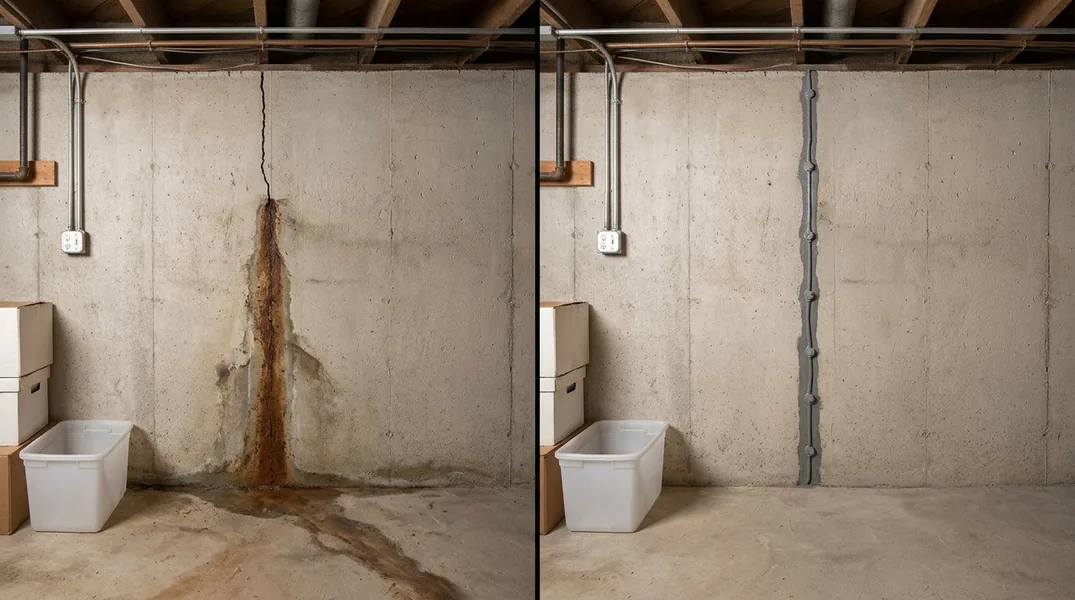
The problem gets worse because till is not uniform. One part of your yard may drain reasonably well while another area holds water like a sponge. During heavy rain or snowmelt, the water table can rise fast. Hydrostatic pressure builds against the foundation, and water finds the weakest point: a hairline crack, a cold joint, a tie rod hole, or the seam where the wall meets the footing. That is why a basement can be dry for years and then suddenly take on water after one unusually wet season.
Signs Your Bridgeport Basement Is Losing the Battle
Homeowners in Stratford and Trumbull often notice the same early warning signs. White powdery stains on the walls, known as efflorescence, mean water is moving through the concrete and leaving minerals behind. Damp smells, peeling paint, and rust on metal fixtures are also clues. You might see a thin line of water along the base of the wall after a storm, or notice that the floor feels sticky or soft in one corner.
These symptoms rarely fix themselves. In fact, they usually get worse because the soil stays saturated and the pressure keeps working on the foundation. If you see any of these signs, it is worth having a professional take a look before the next heavy rain. You can call Bridgeport Waterproofing at (475) 256-5668 or request a free estimate to get a clear picture of what is happening.
Basement Waterproofing Near Me: Solutions That Work With Local Soil
Generic fixes often fail in Fairfield County because they ignore the local geology. A simple coat of sealant on the inside of the wall, for example, does not address the water building up outside. The right approach depends on how the water is entering and how the soil around your home behaves. For many homes, an Interior Drain Tile System is the most reliable solution. It captures water at the footing and directs it to a sump pump before it ever reaches your floor.
In other cases, the best fix is on the outside. Exterior Basement Waterproofing involves excavating around the foundation, sealing the walls, and installing drainage that relieves pressure before it builds. This is often the right choice when the problem is severe or when the goal is to protect the foundation for the long term. A thorough Basement Waterproofing plan may combine both approaches, along with Foundation Waterproofing to seal cracks and joints. The key is to diagnose the actual water path rather than guess.
Basement Waterproofing Cost in Bridgeport: What to Budget
Every basement is different, so there is no single number that fits every home. Factors like the length of the foundation, the type of drainage needed, whether a sump pump is already installed, and how accessible the exterior is all affect the final price. A small interior system for a modest basement is usually less expensive than a full exterior excavation, but the right solution is the one that actually solves the problem.
The best way to understand your options is to get a written assessment. Bridgeport Waterproofing provides transparent pricing so you know what to expect before any work begins. A professional evaluation will also tell you whether a simpler repair might be enough or whether the soil conditions around your home call for a more comprehensive system. For a local homeowner, that clarity is worth more than a generic online estimate.
Protecting Your Home From the Ground Up
Ledge and glacial till are not going away, and they will keep shaping how water moves around your foundation. The good news is that you do not have to live with a wet basement. Understanding the local soil is the first step, and taking action before the next wet season is the second. Small issues tend to grow, and water that finds a crack this year will widen it next year.
If you are ready to protect your home, reach out to Bridgeport Waterproofing. Call (475) 256-5668 or visit the website to schedule a free estimate. A local expert can walk you through what is happening under your home and recommend a solution built for Bridgeport soil, not a one-size-fits-all fix.
Looking for a professional basement waterproofing contractor in Bridgeport? Bridgeport Waterproofing responds fast for all your basement waterproofing needs.
Get a Free QuoteOur services: Basement Waterproofing · Interior Drain Tile System · Exterior Basement Waterproofing